
Safety first
Air conditioning shares the furnace blower in most Ontario homes, and the gas appliances keep running in summer, so the usual rules still apply.
- Gas smell: leave the house without touching switches and without using a phone inside, then call your gas utility's emergency line (for many homes, Enbridge Gas) or 911 from outside.
- CO alarm: get everyone out, including pets, and call 911 from outside. Stay out until responders say it is safe.
- Never remove burner or gas valve covers on the furnace, and do not open the electrical panel on the outdoor unit. The capacitor inside can hold a charge even after the power is off.
- Switch off the power at the outdoor disconnect before you touch or rinse the outdoor unit.
Safe checks you can do
These are in the order a technician would want them. Write down what you find.
- Thermostat. Set to Cool, with the set point a few degrees below the room temperature and the fan on AUTO. With the fan on ON, the blower keeps running between cooling cycles, and the air can feel warm and humid.
- Filter. A clogged filter cuts airflow across the indoor coil. Cooling drops, and in time the coil can freeze. Replace it with the right size.
- Registers and returns. Open supply registers and keep return grilles clear.
- Is the outdoor unit running? While the system calls for cooling, you should hear the compressor and see the fan spinning. If the indoor fan runs but the outdoor unit is silent, it likely has no power or a failed part.
- Breaker and disconnect. Check for a tripped breaker marked AC or condenser, and the disconnect box near the outdoor unit. Reset a breaker once; if it trips again, leave it off and call.
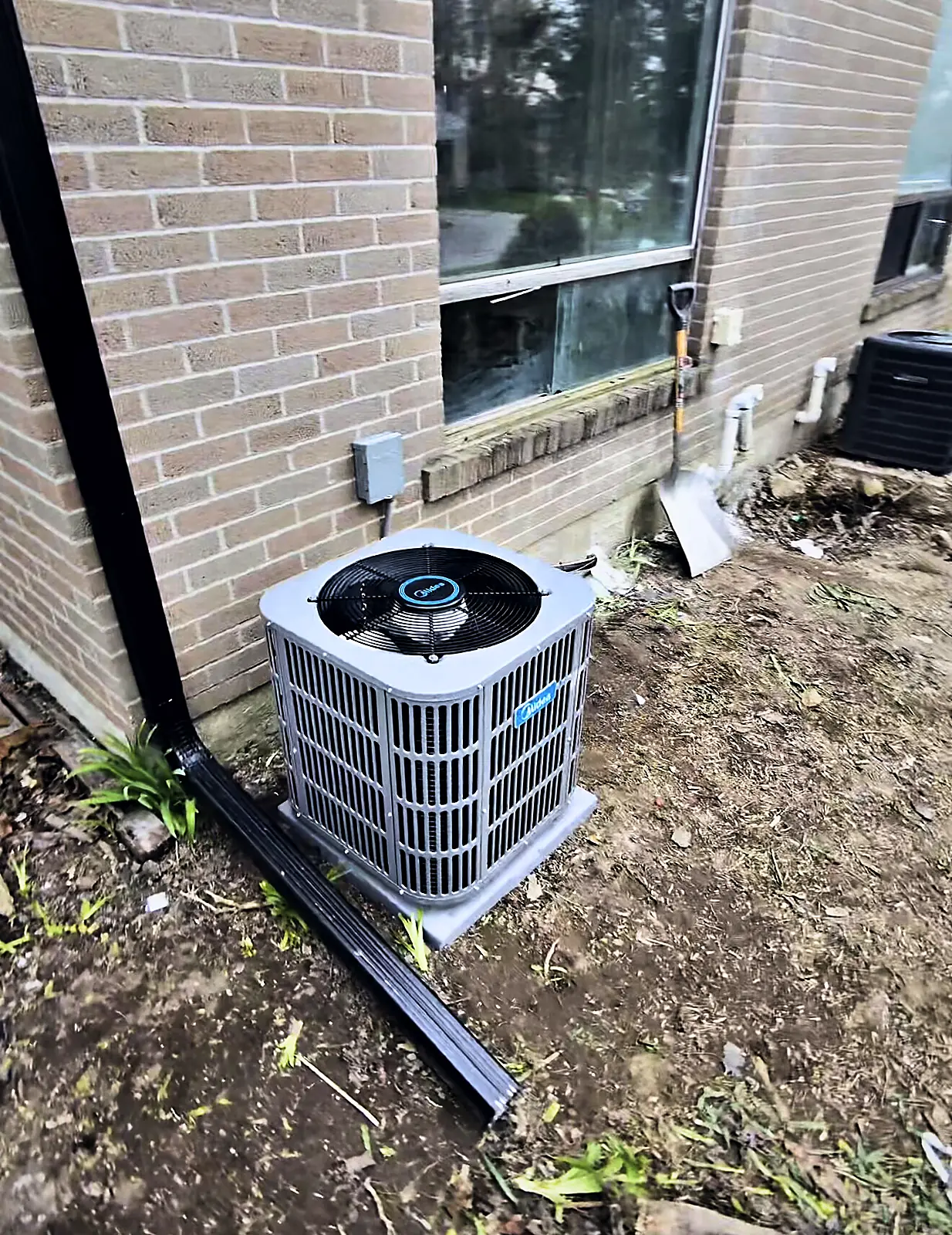
- Clear the outdoor unit. Remove leaves, grass clippings, seed fluff and plants, and trim shrubs back. With the power off at the disconnect, rinse the fins gently with a garden hose. No pressure washer, and do not bend the fins.
- Look for ice. Check the larger copper line at the outdoor unit and, if you can see it, the indoor coil area above the furnace. Ice or heavy frost means the system should be switched off.
- Condensate drain. Water around the furnace or a condensate pump that does not empty can trip a float switch that stops cooling. Note it and wipe up the water.
Ice on the lines: switch it off and let it thaw
Ice on the refrigerant lines or the indoor coil is never normal. It means the coil is running colder than it should, usually for one of two reasons: not enough air is moving across it (a dirty filter, closed registers, a dirty coil or a weak blower), or the system is low on refrigerant because of a leak.
Set the thermostat to Off for cooling and the fan to ON, so the blower helps thaw the coil. Let it melt on its own, which can take several hours, and watch for extra water around the furnace as it does. Never chip at the ice. Running a frozen system can damage the compressor, the most costly part of the system.
A cooling system does not use up refrigerant. If it is low, there is a leak somewhere. Refrigerant handling is regulated in Ontario, and as a general rule only a technician with the required Ontario refrigerant training can add, recover or repair it. A top-up without finding the leak is not a fix.
Likely causes and how urgent they are
Thermostat or fan setting: low urgency
A wrong mode, a set point that is too high or the fan on ON. Fix the setting and wait for a full cycle.
Clogged filter: low to moderate
Replace it. If the coil has iced, let it thaw before you run cooling again.
Dirty or blocked outdoor coil: moderate
The unit cannot shed heat, so cooling drops and running costs rise. Clear and rinse gently; a full coil cleaning is part of maintenance.
Outdoor unit without power: moderate
A tripped breaker or an open disconnect. If the breaker trips again after one reset, book a repair.
Fan or electrical part failure: book a repair
The outdoor unit hums but the fan does not spin, or it clicks and stops. Capacitors and contactors hold live voltage, so leave them to a technician.
Refrigerant leak: book a repair
Ice on the lines, weak cooling that slowly gets worse, or hissing. Switch it off to protect the compressor and call.
When to call
Call if cooling does not return after the checks above, if there is ice on the lines or coil, if the outdoor unit is silent or humming without the fan turning, or if a breaker trips more than once. Our air conditioner repair page explains what the visit covers. During a heat wave, keep blinds closed on the sunny side, run ceiling fans and keep the system off if it has iced.
If your outdoor unit is a heat pump rather than an air conditioner, the same checks apply; see heat pump repair. Many of these problems, especially a dirty coil and a neglected filter, are what a spring AC maintenance visit is meant to catch.
The cost depends on the cause, and a quote follows a diagnosis. A diagnostic fee may apply; it is confirmed at booking.
What to tell us when you call
- The model and serial number from the nameplate on the outdoor unit, and from the furnace or air handler if you can reach it
- Whether the outdoor fan and compressor run, and any sound such as humming, clicking or hissing
- Any error light pattern on the furnace or thermostat message
- Whether you have seen ice, and where
- What you already tried: filter, breaker, rinsing the coil
- Photos of the outdoor unit, its nameplate and any ice or water