
Serving the GTA and nearby Ontario info@kelvinmechanical.ca +1 905-407-7353

Rooftop units (RTU)

Rooftop Unit Replacement, Repair and Service for Small and Mid-Size Buildings

Replacement, repair and planned service for gas/electric and heat pump rooftop units on offices, shops, plazas and other light commercial buildings.

  • ScopeInstall, repair and maintain RTUs
  • EquipmentGas/electric and heat pump rooftop units
  • BuildingsSmall and mid-size commercial
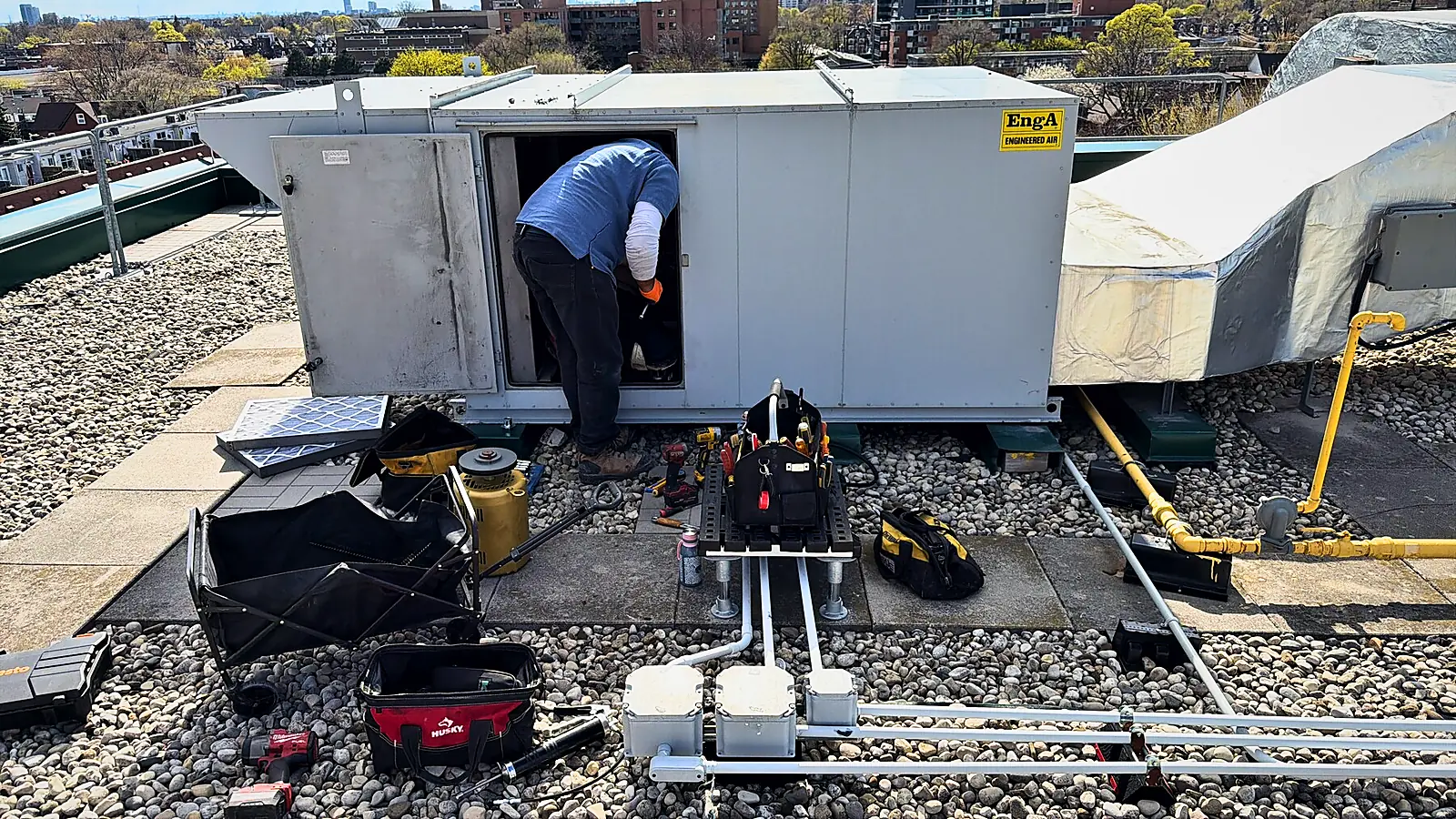
Technician working inside an open rooftop unit on a flat roof with tools laid outServing the GTA and nearby Ontario

Scope

What a rooftop unit job can cover

  • RTU replacement with a curb adapter when the footprint or duct openings differ
  • Crane or lift planning and safe roof access arranged before the unit day
  • Belt, sheave, bearing and blower motor service, with amp draw read against the nameplate
  • Gas heat section checks: ignition, gas valve, inducer, heat exchanger and flue
  • Economizer damper, actuator and sensor testing, with minimum outdoor air set
  • Thermostat or rooftop controller setup, schedules and safety lockout review
  • Refrigerant circuit readings (pressures, superheat, subcooling) plus compressor contactors and capacitors
  • Phase rotation and voltage checks on three-phase units before compressor start

Process

From roof walk to commissioning

Every job starts with a conversation and a look at the equipment. You see the options in plain language before anything is booked.

Request an RTU quote

  1. 1

    Roof walk and nameplate review

    We photograph the nameplate (model, serial, voltage and phase, gas input, refrigerant type), measure the curb and note duct, gas and electrical connections. That tells us whether a like-for-like replacement is practical.

  2. 2

    Curb and capacity decision

    If the new unit's footprint or duct openings differ, a curb adapter bridges the gap. Capacity is confirmed with a load calculation, not a rule of thumb, so the replacement suits how the space is used today.

  3. 3

    Lift and shutdown planning

    We agree on crane or lift arrangements, roof access, tenant notice and a shutdown window with the building contact. Roof membrane work around the curb stays with your roofing contractor.

  4. 4

    Set, connect and start up

    Gas, electrical, duct and condensate connections are completed, then the unit is started with phase rotation, airflow, gas pressure and refrigerant readings checked. Results are logged so the next visit has a baseline.

  5. 5

    Written handover

    You receive a short service note with readings, filter sizes and belt sizes, plus any follow-up items. Gas piping changes are covered on the commercial gas lines page.

In pictures

What this work looks like

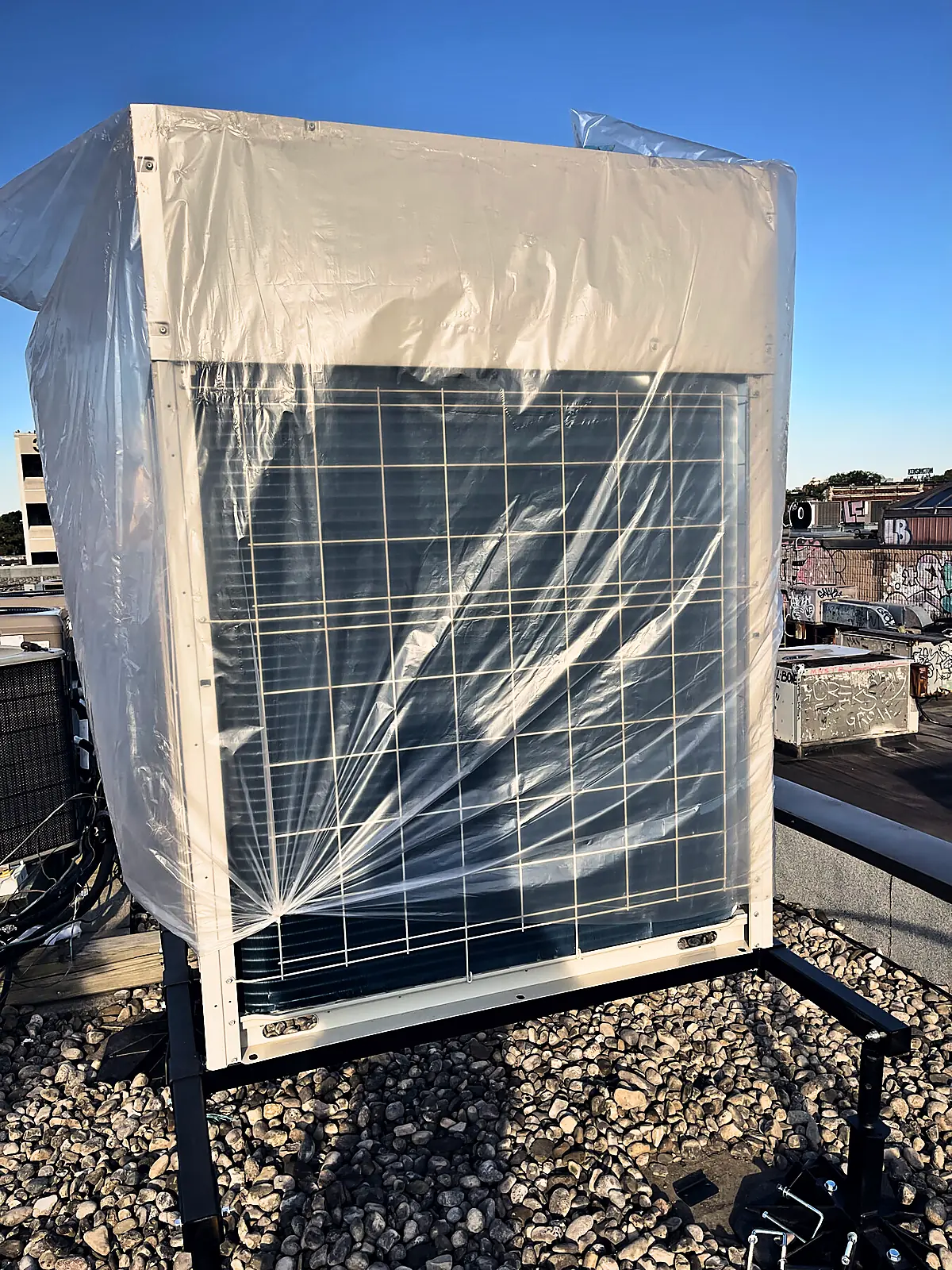
New rooftop unit, still wrappedKelvin job photo
New rooftop unit, still wrappedDelivered to the roof before set-up
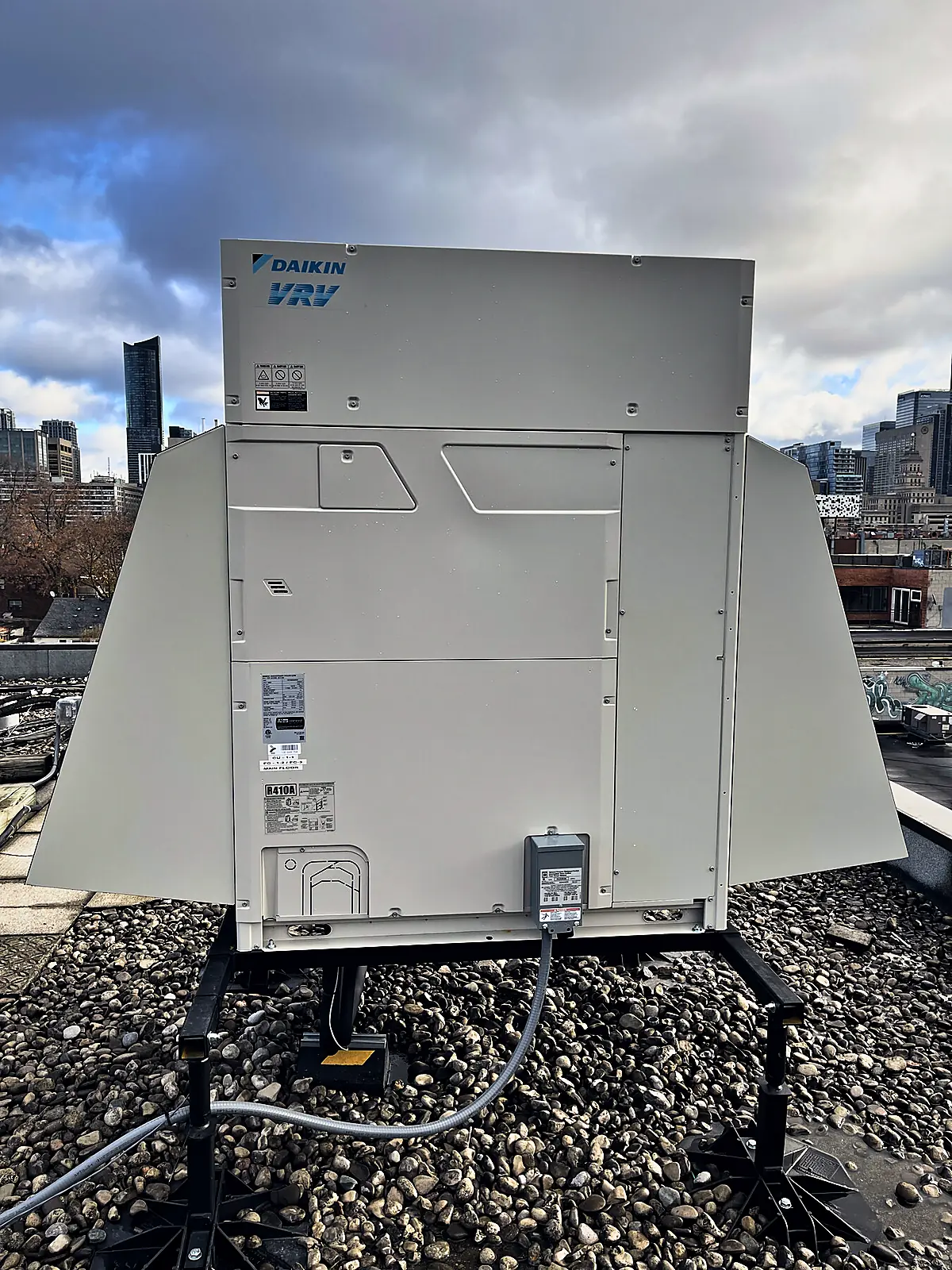
Outdoor unit on a rooftop steel standKelvin job photo
Outdoor unit on a rooftop steel standFlat-roof installation
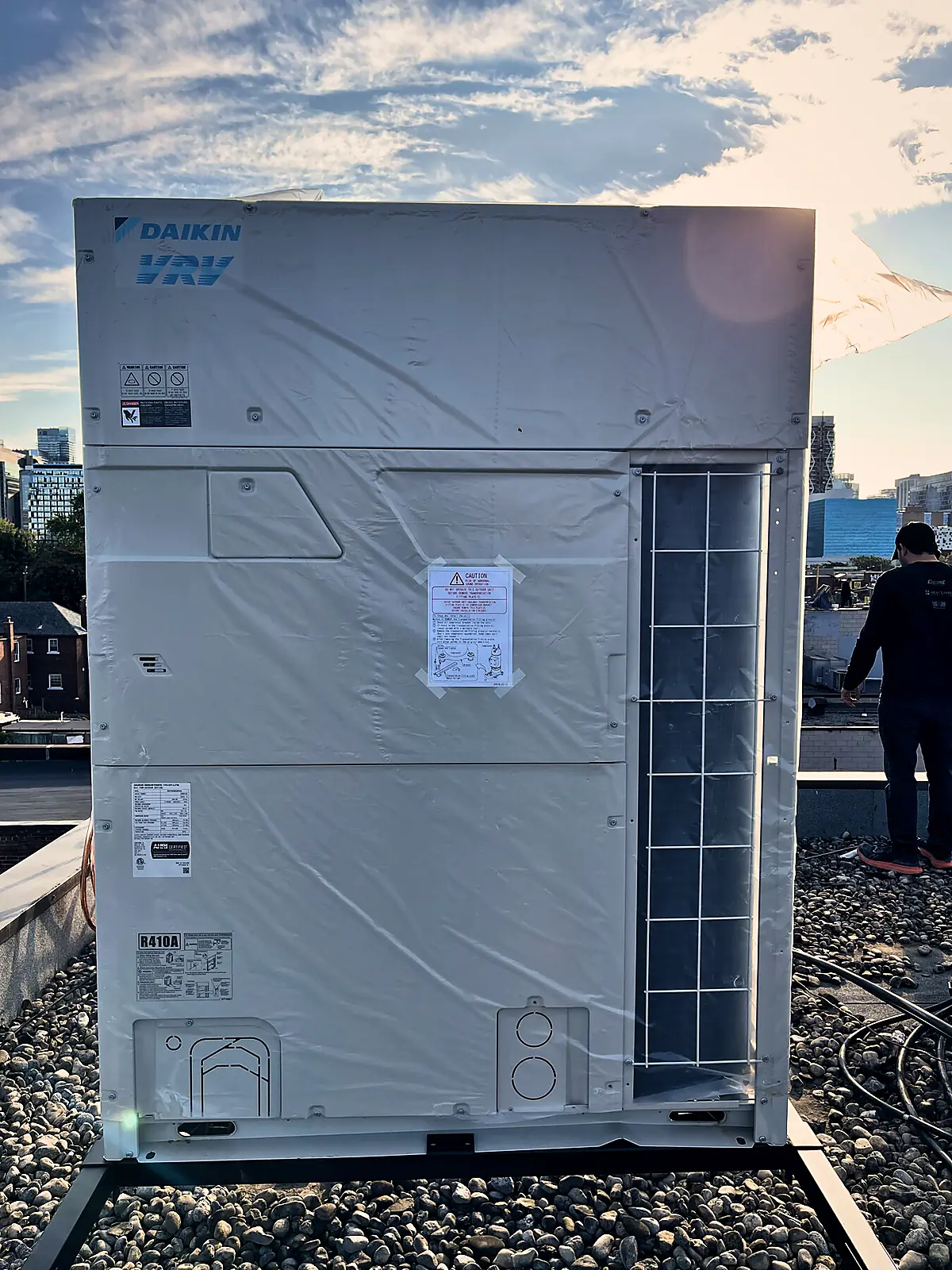
Commercial VRF outdoor unit on a Toronto roofKelvin job photo
Commercial VRF outdoor unit on a Toronto roofLight commercial rooftop equipment

Photos from Kelvin Mechanical jobs in the GTA and nearby Ontario.

Good to know

Rooftop faults we trace first

Blower and belt problems

A squealing belt, worn sheave or failed bearing cuts airflow before anything else shows. Motor amp draw is compared with the nameplate; a high reading points to a bearing, belt tension or a blocked filter rack.

Gas heat section symptoms

No heat can trace to the inducer, pressure switch, flame sensor or gas valve. A cracked heat exchanger is a safety issue, and the unit stays off until it is repaired or replaced.

Economizer and control faults

Stuck dampers, failed actuators or drifting sensors cause cold drafts in winter or lost free cooling in spring and fall. Outdoor air and mixed air sensors and minimum position are tested.

Refrigerant circuit basics

Weak cooling often comes from dirty coils, a failed capacitor or contactor, or low airflow before it is a leak. Pressures, superheat and subcooling are read together. Refrigerant is handled by qualified professionals, and topping up without finding a leak is not a repair.

Install, repair, maintain

01

Installation: curb, lift and start-up

Replacements are planned around the existing curb, the lift and a shutdown window agreed with you. Start-up includes gas, airflow, phase and refrigerant checks.

02

Repair: find the failed part, not just the symptom

Most RTU calls trace to a belt, motor, capacitor, contactor, control board or gas heat component. Repairs are quoted in writing before parts are ordered, and you are told when replacement makes more sense.

03

Maintenance: seasonal visits on a schedule

Filters, belts, coils, drain pans and economizers are checked before the cooling and heating seasons. Findings go into a written note so owners can plan ahead of a failure.

Roof and structure work

Structural review of the roof, curb flashing and membrane repairs are outside our scope and are handled with your roofer or building engineer. We coordinate timing so the unit lift and roof work do not collide.

How do you get a rooftop unit ready for an Ontario winter?

Fall is the time to find problems while the weather is still mild. A heating-season visit on a gas/electric rooftop unit looks at the burner, flame sensor, inducer, heat exchanger condition and flue, and tests the safety controls. It also checks that nothing on the roof will block the unit once snow arrives.

Cooling parts need attention too. Condensate lines and drain pans should be clear so water does not back up and ice over, and economizer dampers should move smoothly so cold outdoor air is not drawn in when it should not be. Thermostat schedules and setbacks are reviewed so the unit is not working harder than the building needs.

Each visit ends with a written note listing readings, filter sizes and anything that should be watched. That note is the record you use next season, and it helps a property manager or owner decide what to repair now and what to plan for later.

  • Burner, flame sensor, igniter and inducer tested for steady, safe operation
  • Heat exchanger and flue inspected for damage, corrosion or blockage
  • Condensate line and drain pan cleared, with low spots that can ice over noted
  • Economizer dampers, actuators and outdoor air sensors tested
  • Intake louvres, screens and the area around the unit cleared of debris
  • Thermostat schedule, setback and lockout settings reviewed and written down

Help centre

Questions about Rooftop Units

Can a new RTU use my existing curb?

Often yes, if the footprint, duct openings and weight are compatible. If not, a curb adapter can bridge the difference. We confirm dimensions during the site walk and may ask your roofer or building engineer to weigh in on the roof.

Do you handle the crane?

We coordinate crane or lift arrangements as part of the project scope. Street access, overhead lines and roof access are reviewed during the site walk. Details depend on the site and are confirmed in the written scope.

Should I repair or replace an older rooftop unit?

It depends on the failed part, the unit's condition, its refrigerant type and your plans for the building. A cracked heat exchanger or failed compressor often points toward replacement, while a belt or motor usually does not. We explain both options in writing.

Can you service RTUs you did not install?

In most cases, yes. Send nameplate photos and a description of the problem through Build My Quote. We confirm what we can do after reviewing the unit and the roof access.

Do you work on large industrial rooftop equipment?

No. We focus on light commercial rooftop units serving small and mid-size buildings. If your equipment is outside that range, we will say so instead of taking on the job. See the full Commercial / Mechanical overview for scope limits.

How long does a rooftop unit last in Ontario?

There is no fixed number. Service life depends on how often the unit runs, how well filters and coils are kept, the roof environment and how the unit was sized. Ontario winters and humid summers both work the equipment hard. Units that get regular seasonal visits tend to hold fewer surprises. A written equipment list with ages helps you plan ahead.

Do I need a permit to replace a rooftop unit in Ontario?

It depends on the work and the municipality. A like-for-like replacement may be treated differently from a larger unit, a new curb, new gas piping or new electrical service. Roof loading can matter too. Rules differ by municipality and change, so we confirm what applies in the written scope before work starts. Your landlord may need to approve roof work as well.

Why is my rooftop unit not cooling in summer?

Common causes are a dirty filter or coil, a failed capacitor or contactor, a tripped safety, low airflow or a refrigerant leak. Check the thermostat mode, the breaker and the filter first. Do not keep resetting a unit that trips repeatedly. Send a nameplate photo and any display code through Build My Quote, or call +1 905-407-7353 so we can plan the visit.

Why is my rooftop unit not heating in winter?

On a gas heat section, the usual suspects are the inducer, pressure switch, flame sensor, igniter or gas valve. Snow or ice at the intake or flue can also stop a unit. Check the thermostat and the breaker only. If you smell gas, leave the building and call 911 or the gas utility first. Otherwise call +1 905-407-7353 with the display code.

How often should rooftop unit filters be changed?

It depends on the building. A dusty shop or restaurant loads filters faster than a quiet office. Many buildings check filters monthly and change them every few months, then adjust from what they find. Record the filter size so staff can reorder. A restricted filter lowers airflow, strains the blower and can lead to coil problems.

Can a rooftop unit be replaced with a heat pump rooftop unit?

Sometimes. A heat pump rooftop unit suits some buildings, but heating output drops as outdoor temperature falls, so backup heat and electrical capacity have to be reviewed. The building's heat loss, power supply and gas availability all matter. We look at these during the roof walk. See packaged units for how heat pump formats compare.

What should I do about snow and ice around a rooftop unit?

Snow drift can block intakes and flues, and ice can build up on condensate lines and coils. Clear only what you can reach safely from the ground or a protected access point. Do not climb onto a snowy or icy roof. If the unit has stopped, note the display code and call +1 905-407-7353.

Why does my rooftop unit turn on and off all the time?

Short cycling can come from an oversized unit, a dirty filter, a thermostat in the wrong spot, a tripping safety or low refrigerant. Frequent starts wear contactors and compressors. A site review checks airflow, thermostat location and safety trips before parts are replaced. Send a request through Build My Quote to book that visit.

Where we do this work

Rooftop Units in Toronto, the GTA and Hamilton

Toronto Mississauga Brampton Vaughan Markham Oakville Burlington Hamilton All service areas

Quote and booking

Request: Rooftop Units

Share a few details and we will follow up. A written quote comes after a site review. There is no online checkout.

  • City and service type help us route your request
  • Urgency and property details let us prepare properly
  • Optional equipment photos speed up repairs and replacements

Prefer to talk? +1 905-407-7353

Gas smell or carbon monoxide alarm? Leave the building and call 911 first. Do not use this form.