
Repair or replace: the questions that settle it
Age alone does not decide this. A well-kept furnace can run reliably longer than many homeowners expect, and a neglected one can turn into a repair bill much sooner. What matters is condition, safety and what the next repair actually buys you.
Start with safety. A failed heat exchanger, repeated flame rollout trips or a venting fault are not run-it-until-spring problems, and a qualified gas professional should assess them before the furnace runs again. Then look at the pattern. The same part failing twice, a control board and an inducer motor in one season, or a model whose parts are hard to source all point toward replacement. A single, well-understood fault on an otherwise sound unit is a fair case for furnace repair.
- A safety item such as the heat exchanger, venting or combustion has failed inspection
- Repairs keep recurring, and each one involves a different major part
- Comfort is still poor after filters, returns and controls have been checked
- You are also planning a new air conditioner or heat pump that would pair better with new equipment
Ask your technician what the repair fixes, what is still original in the unit and what is likely to fail next. A good answer is specific.
Why a load calculation comes before a model number
Be cautious of any quote that sizes a furnace by floor area alone. Heat loss depends on insulation, window area and quality, air leakage, ceiling heights, exposure and the shape of the house. Two homes with the same floor area can need very different equipment, which is why a proper load calculation or site review is required before capacity is chosen.
A room-by-room heat loss calculation (in Canada this is commonly done to CSA F280) gives the capacity the house needs on a design-day cold night. The site review then checks whether the ductwork can move the right airflow. An oversized furnace short cycles, runs louder and can leave rooms uneven. An undersized one runs flat out on the coldest nights.
Homes also change. A detached house that has had attic insulation topped up and windows replaced since the old furnace went in often needs less heating capacity than the original unit supplied. Replacing like for like copies a sizing decision made years ago.
Ontario houses we are often asked about
In our experience, the surprise on a replacement job is rarely the furnace itself. It is usually the return air, the vent route or the chimney. These are the situations that come up most often in Ontario homes.
Older detached homes with thin return air
Many older houses have one undersized return, or returns boxed into joist spaces. A new furnace with a stronger blower will expose that as grille noise, high static pressure and weak airflow. We measure static pressure and look at adding or enlarging return paths before equipment is chosen.
Townhomes and semis
Mechanical closets are small and the vent has a limited wall to exit through. Sidewall vent and intake locations must keep clearances from windows, meters and walkways, so the exit point is planned before the model is.
Finished basements
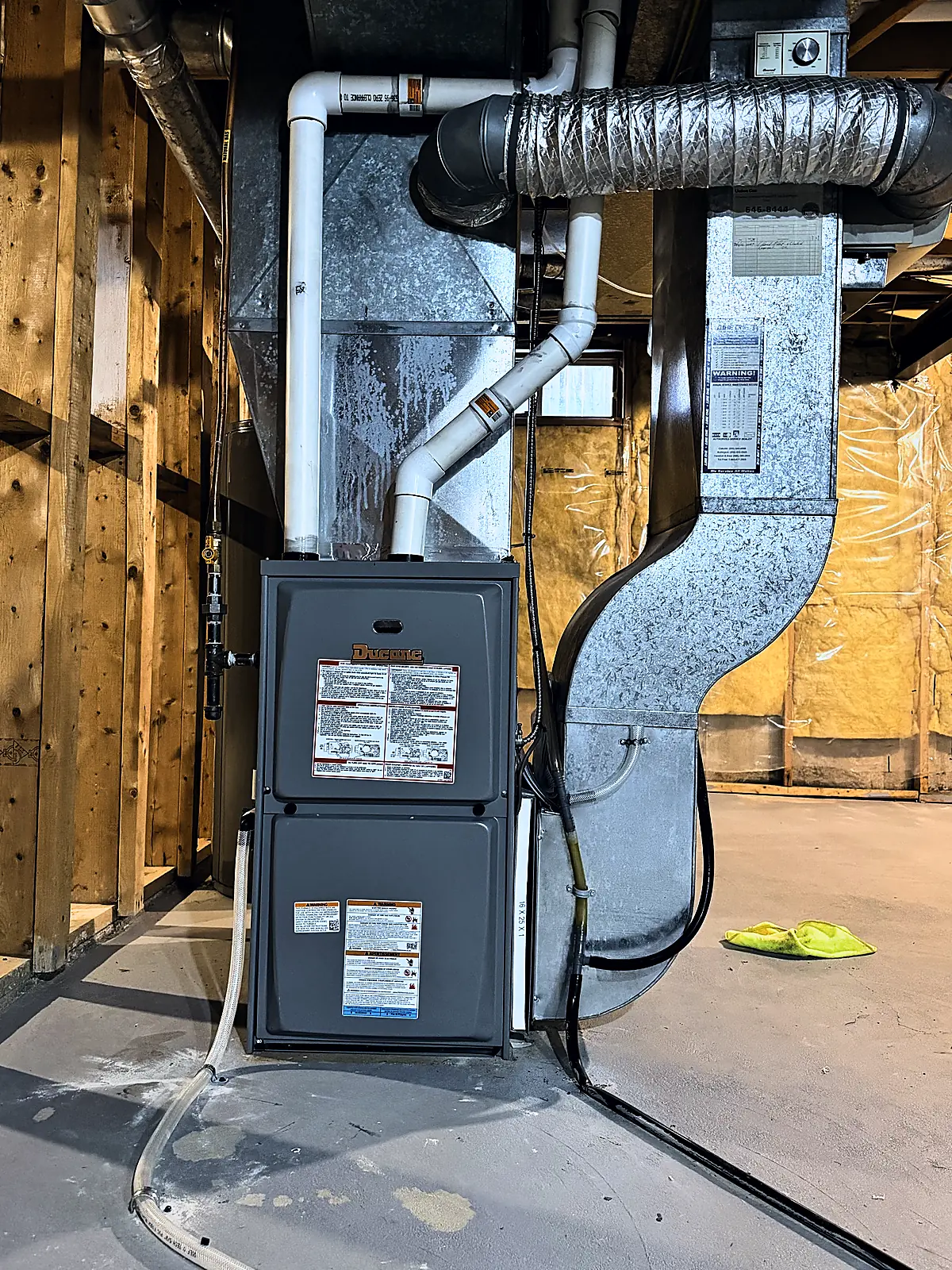
When the furnace sits behind finished walls, service access, clearances and combustion air all matter. A condensing furnace also needs a condensate path; with no floor drain nearby, a condensate pump or a different route has to be planned.
Homes with an old masonry chimney
When a mid-efficiency furnace is replaced by a condensing model, the old chimney often still serves a gas water heater. It may need a liner, or the water heater may need a different venting method. Ask for this to be checked and written into the scope.
Single-stage, two-stage and modulating, side by side
Stages describe how the burner and gas valve respond to demand. Higher-stage furnaces are usually paired with a variable-speed ECM blower, which adjusts speed to duct resistance, uses less electricity than an older PSC motor and can circulate air gently between heating calls.
| Type | How it fires | What you may notice | What to confirm |
|---|---|---|---|
| Single-stage | One firing rate: full output, then off | Simplest design. Cycles more often, and room temperatures can swing a little more | Blower and ductwork handle full-output airflow quietly |
| Two-stage | A low and a high firing rate | Runs longer at the lower rate most of the time, which tends to feel more even and quieter | Thermostat or control compatibility, and when the furnace steps up to high |
| Modulating | Adjusts output in small steps to match demand | Closest to continuous, gentle heat with the most even rooms and lowest blower noise | Control compatibility, duct capacity at low airflow, and local service support |
None of these is automatically right. A well-sized single-stage furnace on good ductwork can outperform a modulating one pushed through restricted returns. Efficiency rating (AFUE), staging and blower type (ECM or PSC) are separate choices, so ask for each on the quote.
Matching the furnace with air conditioning or a heat pump
The furnace blower moves air for the air conditioner too, so replacing one affects the other. If the AC is aging, doing both together lets the outdoor unit, evaporator coil and blower be matched, and lets the installer confirm airflow for heating and cooling. If the AC is newer, ask whether the existing coil and refrigerant lines suit the new furnace. See air conditioner installation for the cooling side. Humidifiers and air cleaners connect to the same duct system, so plan them at the same time.
A heat pump can also sit alongside a gas furnace as a hybrid system, with the heat pump handling milder weather and the furnace taking over when controls call for it. That needs correct coil placement and a thermostat that manages both. If you are weighing that route, read the Heat Pump Selection Guide before you choose furnace features.
Reading furnace warranties: parts, labour and add-on plans
These are separate documents with separate rules. The manufacturer warranty covers defective parts for a stated term, often with a longer term on the heat exchanger than on electrical parts. It usually has conditions such as registration within a set window and proper installation, and it rarely pays for labour.
The labour warranty comes from the installer. It covers workmanship and the labour to correct an installation fault for the term they state, so ask for it in writing with a start date and exclusions. An extended warranty or service plan is a third thing, sold separately with its own exclusions and claim process. Financing spreads the payment and does not extend any coverage.
Terms vary by model and by offer, so read the documents for the exact unit. Questions about financing and extended warranty options are welcome; any offer is subject to provider approval, terms and expiry. Many manufacturers also expect regular servicing, so check your documents and see furnace maintenance.
What moves the price of a furnace replacement
- Furnace type and efficiency level: single-stage, two-stage or modulating
- Capacity, set by the load calculation rather than by the old unit
- Venting: sidewall or roof termination, plastic pipe runs, chimney liner or a change to the water heater vent
- Gas line size and the length of run to the furnace
- Ductwork: added or enlarged returns, plenum transitions, sealing and cooling coil fit
- Condensate handling: drain path, pump or neutralizer
- Electrical: a dedicated circuit or disconnect where needed
- Controls and accessories such as the thermostat, humidifier or air cleaner
- Access: attic or tight closet installs, stairs and removal of the old unit
- Permits and inspections where required, and the warranty options you select
Pricing varies with equipment, venting, ductwork, installation complexity and warranty options; a quote follows a site review. Start with Build My Quote, and when you hold two quotes side by side, compare the written scope first and the total second.
What replacement day involves and how to prepare
- Walkthrough to confirm the scope, the access path and where protection goes
- Shut-off and removal of the old furnace, with disposal as listed in your written scope
- New furnace set in place, with venting, gas, electrical, condensate and duct transitions connected
- Gas leak test and combustion check, then temperature rise and airflow checked against the nameplate
- Thermostat setup, safety control checks and a walkthrough of how to use the new system
- Registration paperwork and a record of settings for your file
Clear the area around the furnace, secure pets, and tell the crew about low headroom or tight stairs. For the full scope of what we install, see furnace installation.