
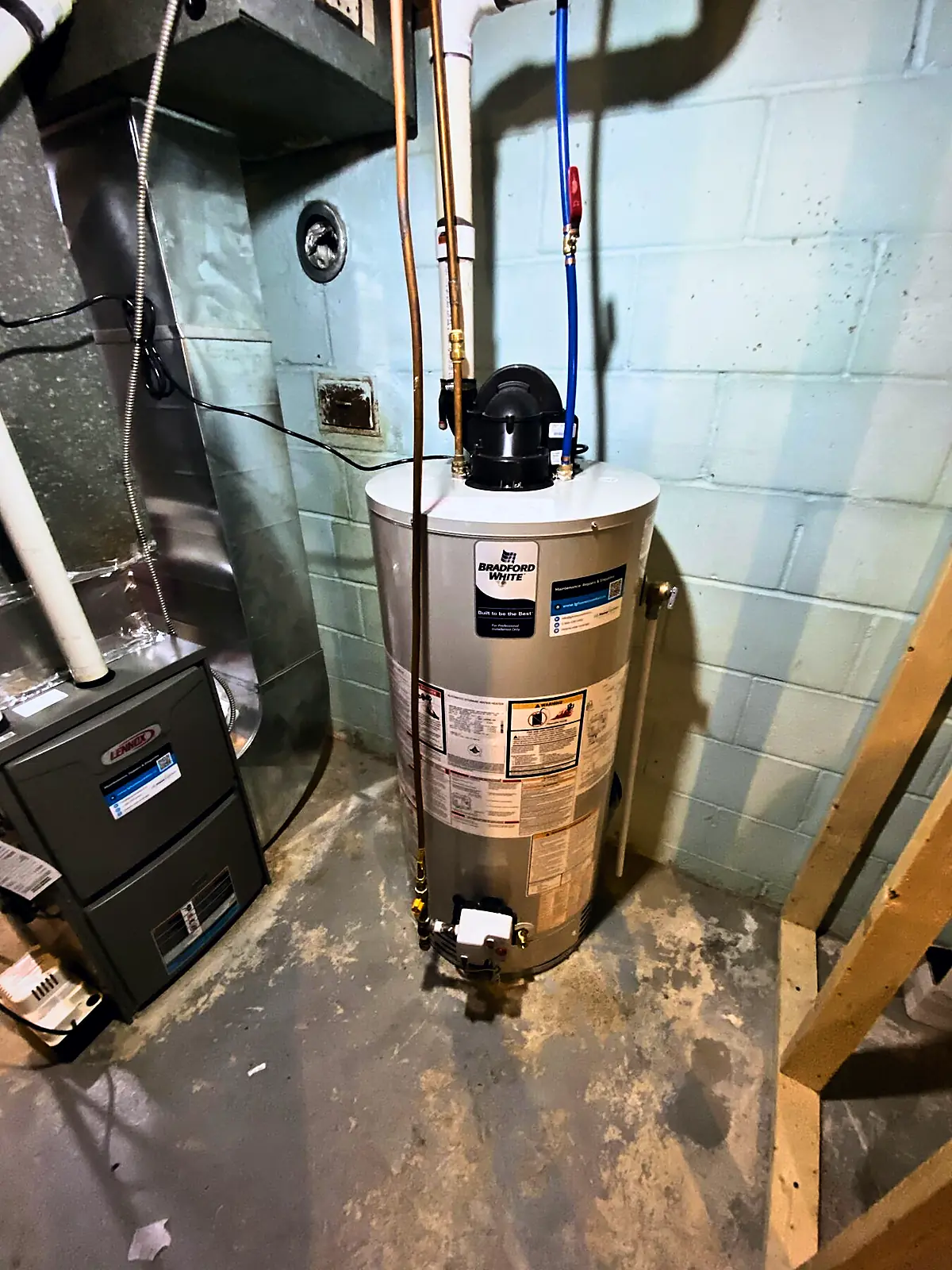
Six water heater types compared at a glance
Hot water is a daily service that nobody notices until it stops. The table covers the main options in Ontario homes. Read it as a starting map; the right pick depends on your venting, fuel, space and household.
| Type | Best fit | Venting and space | Maintenance | Things to watch |
|---|---|---|---|---|
| Gas tank, natural draft | Homes with a sound chimney and steady, moderate hot water use | Vents up a chimney or flue; needs combustion air; takes floor space | Periodic flush, anode and T&P valve checks | Chimney condition and liner; confirm draft and combustion air |
| Gas tank, power vent | Homes with no usable chimney, or where a sidewall vent is easier | Fan-assisted vent through the wall in plastic pipe; needs an electrical outlet nearby | Flush, anode and T&P checks; inspect the vent terminal and fan | Fan noise; no hot water in a power outage; vent termination clearances |
| Electric tank | Homes without gas, or where venting is not practical | No venting; needs a suitable electrical circuit, floor space and a drain pan | Flush, anode and heating element checks | Operating cost follows your electricity rate plan; recovery is often slower than gas |
| Gas tankless, condensing | Households that want continuous hot water and a wall-mounted unit | Plastic vent and intake pipes; condensate drain, often with a neutralizer; gas line must carry the higher input | Descaling intervals depend on water hardness; check filters and error codes | Gas line sizing, minimum flow, winter temperature rise and scale on hard water |
| Electric tankless | Small loads, suites or locations without gas | No vent; can need large dedicated circuits | Element and inlet screen checks | Panel capacity is often the limiting factor |
| Heat pump (hybrid) tank | Homes with a basement or large room where cooler, drier air is acceptable | No combustion venting; needs air volume or ducting, a condensate drain and clearances | Air filter cleaning, condensate check, flush and anode | Room temperature affects performance; fan noise; physical size; backup electric elements |
Our pages on water heaters, tankless water heaters and electric and heat pump water heaters show what each install involves.
Matching capacity to the people in your home
Tank size alone is a poor guide. For tanks, look at the first-hour rating, which describes how much hot water the heater can deliver in the first hour of heavy use. For tankless units, look at flow rate and temperature rise. In an Ontario winter the incoming water is cold, so the same tankless unit delivers less flow at a given outlet temperature than in summer.
Think about peak use rather than average use. Two showers running while the dishwasher fills is a very different demand from one person at a time. Soaker tubs, teenagers, guests and a home office turned into a suite all change the picture. Tell your installer how the household actually uses hot water, and what is likely to change.
Venting, gas supply and the space you really have
A water heater is only as flexible as its venting and utility connections. Natural draft models need a working chimney. Power vent and condensing tankless models vent through the wall but need clearances from windows, doors, meters and walkways. Heat pump models need air volume or ducting around them and a place for condensate to go.
Gas tankless units draw a much higher gas input than a tank, so the existing gas line, meter and regulator may need review. Every install also needs a safe discharge path for the temperature and pressure relief valve, and often a drain pan or leak detection. Work should follow code, with permits and inspections where required. See water heater installation for scope.
Water quality decides how long the equipment keeps its edge
Hard water leaves scale inside tanks and on tankless heat exchangers, which reduces efficiency, adds noise and can shorten service life. Sediment settles at the bottom of tanks, and homes on private wells can see more of it. Tankless units are especially sensitive to scale because of their narrow passages.
Test your water hardness before choosing, not after the first error code. If hardness is high, a softener, a scale-control device or a firm descaling schedule belongs in the plan. See water softener installation and water treatment service for options.
Maintenance and running cost: what the numbers depend on
- Fuel and rate plan: natural gas, electricity and your time-of-use or tiered plan all change running cost
- Efficiency rating: compare ratings for the models quoted, using the same method
- Standby loss: tanks keep water hot all day; tankless units heat on demand
- Maintenance interval: flush, anode inspection and valve checks for tanks; descaling for tankless; filter and condensate care for heat pump models
- Water hardness: more scale means more frequent service
- Parts and service support for the model in your area
Costs here are factors, not figures. Pricing varies with equipment, venting, ductwork, installation complexity and warranty options; a quote follows a site review. A yearly look under water heater maintenance usually costs less than an emergency replacement, and water heater repair can extend the life of a unit that is otherwise sound.
Rental or ownership: what actually changes
With a rental, the equipment stays the property of the provider and you pay a recurring charge. The contract may include service or replacement, but it may also have a term, a buyout price and removal or early termination conditions. Read what happens if you sell the house or want to switch the type of heater.
With ownership you hold the equipment and choose who services it. You carry the upfront cost, which can be spread through financing, and you have the manufacturer warranty plus the installer's labour warranty. These are different things, and so is an extended warranty. Any financing, lease-to-own or rental offer is conditional, subject to provider approval, terms and expiry. See financing and extended warranty options for the differences.
Long-term value beyond the purchase price
Think in terms of total cost of ownership over the equipment's service life: purchase and installation, fuel, maintenance, likely repairs and the eventual replacement. A cheaper tank can cost more over time if it is hard on fuel or fails early on hard water. A tankless unit that is under-maintained can lose its advantage quickly.
Also weigh what the choice does to the rest of the house. A heat pump water heater pairs naturally with a home moving toward electric heating. A power vent unit solves a chimney problem. A tankless unit reclaims floor space. If you want help weighing them against your own water, venting and fuel, use Build My Quote and we will arrange a site review.